
OGE Nexus: Visiting Sites of Chinese Cultural Heritage
Teachers College, Columbia University | January 2026
Internetaional Education & Collobraotive Project
Role: Program Initiator, Co-Developer & Instructor
OGE Nexus: Visiting Sites of Chinese Cultural Heritage is an immersive international learning program developed through Teachers College, Columbia University’s Office of Global Engagement. The program brings together art, education, cultural heritage, and place-based inquiry through direct engagement with the cultural, architectural, and aesthetic landscapes of northern China.
Working collaboratively with Chris Moffett and Jun Hu, I contribute to an interdisciplinary learning experience that takes participants from Beijing to Shanxi Province, engaging with sites including the Great Wall, Yungang Grottoes, the Hanging Temple, Yingxian Wooden Pagoda, and Pingyao Ancient City. Through close observation, critical reflection, arts-based research, a/r/tography, and multimodal inquiry, participants examine the material, spatial, aesthetic, and cultural dimensions of Chinese heritage.
The project reflects my broader research interests in aesthetics, embodied and place-based learning, Chinese philosophy and culture, art education, and environmental humanities. Rather than approaching cultural heritage solely as an object of historical study, the program considers how encounters with art, architecture, landscape, and place can generate forms of experiential and embodied knowledge while fostering intercultural dialogue.
View the OGE Nexus Program at Teachers College, Columbia University

Reverse Inclusion: Rethinking Disability Through Art Education
Research & Practice Project | 2019–Present
Role: Researcher
Reverse Inclusion is an ongoing research and practice-based project that explores alternative approaches to disability, inclusion, and embodied learning through art education. Initiated in China in 2019 in collaboration with Professor Jun Hu, the project questions conventional models of inclusion in which students with disabilities are expected to enter and adapt to learning environments primarily structured around normative sensory and bodily experiences.
The project reverses this orientation by asking how educational environments might instead be reorganized around diverse modes of perception and embodiment. Rather than positioning disability primarily in terms of limitation or accommodation, Reverse Inclusion creates situations in which different sensory and bodily experiences become generative conditions for artistic inquiry, learning, and social interaction.
Through multisensory art experiences—including tactile painting, sound-to-image activities, color narratives, sensory-restricted artmaking, and collaborative workshops, the project invites participants to reconsider familiar relationships among vision, touch, sound, movement, and artistic expression. These activities shift attention from what a body is presumed to lack toward what different bodies can perceive, experience, and create.
Theoretically, the project brings critical disability studies into dialogue with phenomenology, particularly questions of embodiment, perception, and intercorporeality. It considers inclusion not simply as providing access to an already established educational environment, but as an opportunity to rethink the assumptions through which learning environments, artistic practices, and concepts of ability are constructed.
As both research and pedagogical practice, Reverse Inclusionasks a broader question: What might art education become when differences in bodily and sensory experience are understood not as obstacles to learning, but as sources for reimagining how we perceive, create, and learn together?
Here is the link of artwork created by children with blindness
Professional Leadership in Creative Arts Education
International Association for Creative Arts in Education and Therapy (IACAET)
Professional Leadership & Interntaional Colloboration Project
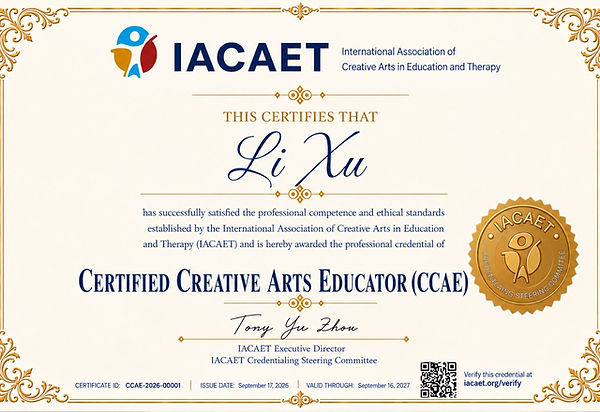
Role: Co-Chair, Creative Arts Education Credentialing Committee | Certified Creative Arts Educator (CCAE)
I serve as Co-Chair of the Creative Arts Education credentialing initiative of the International Association for Creative Arts in Education and Therapy (IACAET), an international professional organization dedicated to advancing creative arts across education, therapy, health, community, and related interdisciplinary contexts. IACAET promotes global dialogue and collaboration while supporting the development of professional standards and ethical practices in creative arts education and related fields.
As Co-Chair, I contribute to the development and implementation of professional standards for creative arts educators and participate in the review of CCAE applications, evaluating applicants’ professional preparation and practice in relation to the credential's established criteria. This work reflects my broader commitment to advancing art and creative arts education through international collaboration, professional service, and the development of rigorous and inclusive standards for the field.
In 2026, I became the inaugural recipient of the Certified Creative Arts Educator (CCAE) credential, becoming the first professional to receive this credential in the field. Awarded in recognition of demonstrated professional competence and ethical standards in creative arts education, my credential carries the designation CCAE-2026-00001.

Book: Linking Arts with Biocultural Conservation, Restoration, and Communication
Interdisciplinary Book & Research Project | Springer Nature, 2026
Role: Co-Editor & Contributing Author
Linking Arts with Biocultural Conservation, Restoration, and Communication is an interdisciplinary book project exploring how the arts can contribute to understanding, communicating, and sustaining biological and cultural diversity. Published by Springer Nature as part of the Ecology and Ethics series, the volume brings together perspectives from artists, philosophers, ecologists, educators, and scholars working across diverse cultural and geographical contexts.
At the center of the project is a shared question: How can artistic and aesthetic practices help cultivate more meaningful relationships among people, cultures, places, and the more-than-human world? Moving across theory, artistic practice, environmental education, and community engagement, the book challenges conventional divisions among the sciences, humanities, and arts. Its three sections examine theoretical approaches to biocultural conservation, practical and artistic engagements with biodiversity, and strategies for biocultural communication across urban, rural, and remote environments. As a co-editor, I contributed particularly to the intersection of art, aesthetics, embodied experience, education, and environmental thought. I co-authored the introduction to Part II, “Practical Knowledges Embedded in Biocultural Diversity,” which examines embodied, place-based, and experiential forms of ecological knowledge, and co-authored a chapter to this book.
The project reflects my broader interest in bringing philosophy and artistic practice into conversation with environmental humanities. It approaches art not simply as a means of representing nature, but as a mode of inquiry and engagement through which ecological relationships can be perceived, experienced, communicated, and reimagined.

Bridging Roots & Expressions
Curatorial & Exhibition Project | 2026
Role: Curator
Bridging Roots & Expressions is a curated exhibition exploring the interconnected relationships among cultural traditions, ecological systems, artistic expression, and environmental stewardship. Developed in connection with the interdisciplinary volume Linking Arts with Biocultural Conservation, Restoration, and Communication (Springer Nature, 2026), the exhibition extends the book’s scholarly conversations into a visual, material, and publicly accessible form. The exhibition brings together 30 original artworks including watercolor, ink and line drawing, calligraphy, photography, fiber, mixed media, text, and video, Through diverse artistic practices and perspectives, these works explore the entanglements of culture, ecology, place, and lived experience.
As a curatorial project, Bridging Roots & Expressions asks how art can make visible the often complex relationships among people, cultural memory, place, and the more-than-human world. Rather than treating nature and culture as separate domains, the exhibition approaches artistic practice as a space through which ecological relationships can be perceived, interpreted, communicated, and reimagined.
Accompanying educational narratives further connect the artworks with questions of biocultural diversity, conservation, and environmental restoration. In this way, the exhibition functions not only as a presentation of artworks but also as a platform for public engagement, interdisciplinary dialogue, and environmental learning.
The project reflects my broader curatorial approach of bringing scholarship, artistic practice, education, and public engagement into conversation. By translating ideas developed through interdisciplinary research into an exhibition environment, Bridging Roots & Expressions explores how curatorial practice itself can become a form of inquiry—one that creates encounters among artworks, ideas, communities, and ecological worlds.
Vies some selected artworks from this exhibition